Saturday, February 9, 2013

Jen Stark


Jen Stark's work consists of a lot skilled color matching and serial planes, the subject of our next assignment. I first discovered her back in the fall and fell in love with her work immediately. (One of my favorite pieces is "Centrifugal" you can find her at jenstark.com)
 
When you consider serial planes you must first consider how everything starts with a point, followed by a line, and so on. Points make up a line, lines make up planes, and planes create volume, which then creates form. When you break down a form at regular intervals you get serial planes. Each plane is its own unit and can create volume through repitition or gradation (shape/size). The repition while changing size will create a sense of depth (like in the first & second image). Varying the shape and size in repition will give you more interesting forms like Jen Stark's work (the third image).
 
Another thing I love about Stark's work is the colors she uses. These images are better for describing her use of serial planes, if you take the time to browse her website you will see all of the color combinations she uses. Those who have study some color theory know basic principles of how colors effect each other and how we percieve them. I enjoy her pieces that combine colors to give the illusion of motion the most!
 

Friday, February 8, 2013

Outline One


Eleanor Goodfellow
Foundation Design II
Heather Ujiie
February 8, 2013


Outline


When designing you combine design elements and principles together to create successful works of art.

Design Principles
-focal point
-balance
-rhythm
-unity
-harmony
-emphasis
-scale
-proportion

Design Elements
-line
-shape
-volume
-mass
-texture
-time
-kinetics(motion)
-value
-color
-illusion of space
-virtual space

To Abstract
-distort
-simplify
-convey meaning

Content: the narrative/idea/subject
Form: manipulating visual elements and materials.
Analysis: researching possible solutions to the proposed problem
Perception: the process of obtaining awareness and understanding of sensory data.
Material Exploration: the experimentation and process of building an idea.


2D: length and breadth

3D: depth, height, width
When working with 3D form consider light, relief, structure, etc.
Defined by x,y, z.

Does form determine function? And how do they affect each other?

And

How do two-dimensional and three-dimensional forms affect each other?

Everything in the universe, as we know it, is made of polyhedral forms (mostly on a microscopic level).

Artists
-Constantine Brancusi
-David Smith
-Alexander Bally
-Thomas Ericson
-Frank Lloyd Wright
-Charles Clary
-Helen Macklin

Monday, February 4, 2013

So far...

So this is my paper dude so far. Still working with what I want and now considering how to make this larger and still structurally sound. Will post again later!

Sunday, February 3, 2013

Steph Three continued

Still playing with what I want to do and the needs of the objective. More tomorrow!


Homework One

Foundation Design 2
Heather Ujiie


1.) Describe the design process; it's categories and how it is used as you outline step 1,2,and 3?

-The design process cannot be specifically defined as it differs for every artist. However every artist does loosely follow a certain method when creating a piece of artwork. The design process is a practice of solving a problem using a variety of techniques. It takes multiple steps to come to a solution, these steps goes as follows. Step one involves recognizing whether or not there is a problem and defining it. Step two details coming up with a multitude of ideas to solve the problem by brainstorming, researching, sketching, planning, etc. In step three you refine your ideas to choose the best ones by comparing them to the context of your problem. Eventually you will eliminate all but one solution.

2.) Define three-dimensional form and find a new example using the research links.

-Objects with height, width, and depth (three dimensions). They include actual plane and volume whereas two dimensional forms only capture this through the illusion of plane and volume.

Example: "The Kiss" by Constantine Brancusi 1916

3.) Define space and find a new example using the research links.

-The measurement of distance or area between, around, and/or within the subjects in a composition. In three dimensional art space it is a lot easier to achieve due to the real space provided in the medium used.

Example: "Nautilus" by Charles Ginnever 1976, from the Minneapolis Sculpture Garden.

4.) Define positive and negative space in 3D form, find a new example using the research links.

-Positive Space is the area a subject occupies in a composition.

Example: "Distant Wish" by Peter Callesen 2006

-Negative Space is the area a subject does NOT occupy in a composition, so the area around and between subjects.

Example: "Pot" by Beth E. Peterson 2008

5.) Define direction and find a new example using the research links.

-Direction in art is the management of all different design elements within a composition.

Example: "Counter Cosmo" by Jen Stark 2011

6.) Define scale and find a new example using the research links.

-The size of a subject or design element in proportion to its actual physical size.

Example: "Wireframe Lamborghini" by Benedict Radcliffe 2008

7.) Define point of view and frame of reference, and find a new example using the research links.

Point of View can apply in two different ways.

-the physical position something or someone is being observed.
Or
-the mental attitude of a composition.

Example: "Lava Burst" by Edgar Mueller 2008

-Frame of Reference can also applied in two different ways.

1.) A set of coordinates axes in terms of which movement may be specified to which physical laws may be mathematically stated.
Or
2.) A set of ideas in terms of which other ideas can be interpreted or assigned meaning.

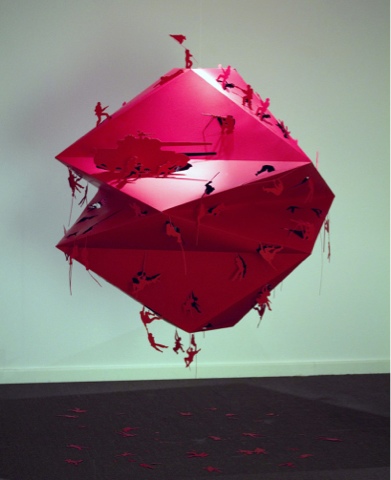
Example: "Red Battle Installation" by LoSiento 2012?


Saturday, February 2, 2013

Step Three

I am still in early stages if development with this idea, when I was originally visualizing this on a much larger scale so attempting a small model is proving to be quite difficult and tedious.

Right now I am on step three of the design process, testing my idea. I decided on a technique of sewing the paper with your basic thread. I am working with index cards because they have a little more weight than regular paper. When I work on the final project I may actually use lighter weight paper for a looser feel.

I will post again tomorrow with more images of the model and the blueprints I created simultaneously.


David Smith


Foundation Design II
Heather Ujiie


David Smith (May 9, 1906- May 23 1965) was an American sculptor who worked with mostly metal materials to create sculptures. Although Smith started his career as a painter after he was exposed to a few famous metal sculptures he became inspired to begin venturing in the same field. Most of his accomplished art was created from scratch unlike many other sculptors of his time who were using molds. A lot of his pieces were three dimensional forms of subjects never before depicted in 3D like landscapes and writing. His most famous work, Cubis, was extremely reminiscent of abstract expressionism and was constructed using a technique of burnishing the steel with a sander. Throughout his career his pieces grew greatly in scale; his last pieces were massive. I find his art very inspirational because welding sculptures is something I have been interested in for a while, but have not had the chance to try. I also admire his continued experimentation in technique and medium. But what I idolize the most is his desire to yield completely original ideas. In my opinion what makes a great artist is the boldness to create something no one else as and taking the risk despite the fear of failure.


Art work pictured by David Smith
"Hudson River Landscape" -1951